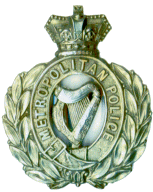
The Dublin Metropolitan Police (DMP) was the police force of Dublin, Ireland, from 1836 to 1925, when it amalgamated into the new Garda Síochána.
Rural policing in Ireland began when Robert Peel, then Chief Secretary for Ireland, created the Peace Preservation Force in 1816. This rudimentary paramilitary police force was designed to provide policing in rural Ireland, replacing the 18th century system of watchmen, baronial constables, revenue officers and British military forces. Peel went on to found the London Metropolitan Police.
A new centralised Constabulary of Ireland was created in 1836 and the Peace Preservation Force ceased to exist. At the same time separate non-paramilitary forces were set up in the larger towns: Dublin, Belfast, and Londonderry. Discipline problems saw the Belfast and Derry forces absorbed by the national force, and only Dublin maintained its separate force.
The DMP was modelled closely on the London Metropolitan Police. Not only were the uniforms of the two forces almost indistinguishable, especially after the helmet and Bath Star were adopted, but the two forces also had a similar organisational structure; rather than a Chief Constable, they were commanded by a Commissioner, who was not a police officer, but a magistrate holding a Commission of the Peace. This was descended from the 18th century system of controlling parish constables, and was a sop to the public's fears about the danger of a standing police force under government control.
The DMP did not take the side of the British in the War of Independence as actively as did the RIC, and as such did not suffer the casualty rate of that force, apart from the political "G" Division. Selected "G men" were first warned by the IRA in April 1919, and the first was shot in July. Many DMP officers actively assisted the IRA, most famously Edward Broy, who passed valuable intelligence to Michael Collins throughout the conflict.
After the creation of Saorstat Éireann, the DMP became known as "Políní Átha Cliath" from 1922-1925, after which the force ceased to exist as a separate entity, and was absorbed into the Garda Síochána. "Dublin Metropolitan" is today a geographic region of the Garda Síochána's command structure.
In common with police forces on the island of Great Britain, the DMP was an unarmed force.