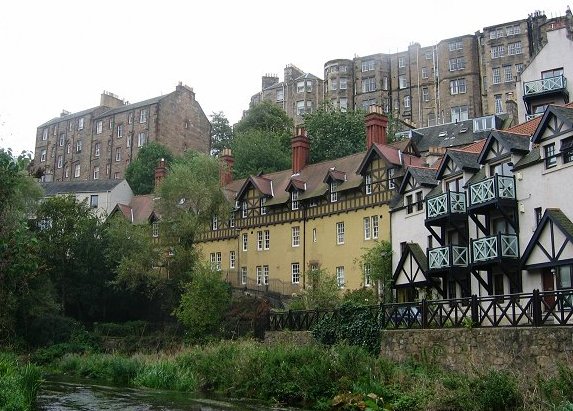
Winding its way through the heart of the city, the Water of Leith is one of Edinburgh's most attractive and important assets. in the 1800s it was the river which drove much of Edinburgh's early economy. Its flow powered 36 flour, paper and snuff mills, bringing great prosperity and, in turn, dictating where bridges were built and where magnificent riverside cityscapes like the Dean Village developed.
Dean Village (from dene, meaning 'deep valley') was known as the "Water of Leith Village" and was a successful grain milling hamlet for more than 800 years.
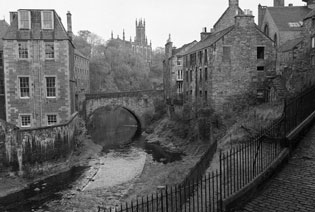
In 1832, the four-arched Dean Bridge, designed by Thomas Telford and 106 feet above the water level, was built to carry the Queensferry Road over the Dean Gorge.
Later the port of Leith began to be very successful, and Dean Village's trade diminished. For many years, the village became associated with decay and poverty. Now the workers' cottages, warehouses and mill buildings have been restored and the area has once more become a desirable residential area. The Water of Leith has become a local amenity, with a waymarked trail, the Water of Leith Walkway, running from Balerno via Dean Village to Leith.