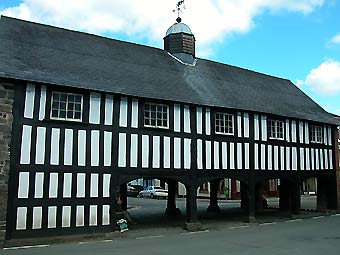
The ancient market town of Llanidloes in Montgomeryshire is in the middle of Wales and is of medieval origin on the banks of the River Severn. The area around Llanidloes was once very important for its thriving flannel industry. It was also a focus of industrial unrest during the 19th century Chartist revolt, a campaign for democratic rights prompted by the collapse of the local textile industry.
The ancient half-timbered market hall (above) stands at the crossroads of the four streets of the original medieval town. Built around 1600, it is the only surviving building of this type in Wales. Assize courts were held in the hall around 1605, and John Wesley preached from a pulpit stone on the open ground floor in 1748.
Llanidloes in 1833 contained 4189 inhabitants. A Topographical Dictionary of Wales, Samuel Lewis, states that:-
"the town is situated in a beautiful and fertile vale, watered by the river Severn, which has its source within the parish, and almost surrounded by verdant hills of moderate elevation, of which some are crowned with thriving plantations, and others are richly cultivated. ....The town occupies a favourable site on the southern bank of the river Severn, and on the turnpike road from Shrewsbury through Newtown to Aberystwyth it consists principally of two spacious streets, intersecting each other nearly at right angles.....
The manufacture of flannel has been established from a very early period in this town, which, forty years ago, was the only place in the county where that material was made, and whence it was conveyed by packhorses to the market of Welshpool for sale. Since that period, however, it has been outrivaled by Newtown, which, within the last twenty-five years, has obtained great eminence in the production of flannel of a finer texture, but probably less durable than that of Llanidloes. The manufacture of this town has, not-withstanding, continued to increase, and there are at present more than forty carding-engines, eighteen fulling-mills, and nearly thirty-five thousand spindles constantly in operation in the town and neighbourhood......"
Flannel
Montgomeryshire was the most important centre of the woven textile industry
in Wales from the mid 16th century, and until around 1790 wool was carded, spun
and woven into fabric in almost all farmhouses and cottages as a winter activity
to supplement the often meagre living from upland farming. Weaving is among
the earliest trades recorded in parish registers.
The area had always been noted for the production of flannel, which was said to have "a softness of texture arising from the quality of the wool which renders them exceedingly well adapted to be worn next to the skin of the most delicate invalid".
In 1797 a new fortnightly flannel market was established in Welshpool. The flannel made around Llanidloes was collected by packhorse or cart from the fulling mills of the district and piled up under the Market Hall in the centre of the town. The bales of around 120 yards of flannel were collected early in the morning by a "large cumbrous waggon" and taken to the Welshpool market.
In the early part of the 19th century the processes were carried out separately, with carding, spinning and fulling operations based in water-powered factories and mills. Weaving, however, was still a manual process carried out in the home or in the upper floors of specially built weavers workshops.
The early stages of industrialisation saw the arrival of handloom weaving shops housed in tall three or four storey buildings, with large open workshops on the upper floors and living quarters for the workers beneath. There was typically an outside staircase for direct access to the looms. A common feature of weavers houses are the large windows in the upper floors to admit as much light as possible. Many buildings in Llanidloes and in Newtown survive from this domestic phase of the evolution of the flannel industry.
The rapid evolution of the flannel industry included periods of depression, with serious disturbances due to low wages and poor working conditions in the 1830's. The weaving masters set up shops on their premises where workers were forced to use tokens to buy essential goods at inflated prices, often leaving them with no wages to take home. In many cases all the members of the family would be working for the same employer, and unable to reach other shops during their opening hours. They were also likely to be sacked for buying elsewhere. These abuses contributed to the Chartist disturbances of 1839.
It was estimated that there were some 25 weaving workshops with a total of around 815 hand looms in operation in Llanidloes in 1838. The weaving shops varied in size between 10 and 60 looms each. The flannel industry brought prosperity to the area, led to the steady increase in the population, and made a number of mill owners and traders very rich.
As a result of the eventual adoption of steam power to drive the looms and other machines, the Montgomeryshire flannel industry became concentrated in the towns of Newtown and Llanidloes .
In 1850 there were nine factories in Llanidloes employing up to 800 workers
making flannel, tweeds and shawls, but the modernisation of the industry in
the county had taken too long.